
COMMON TECHNICAL QUESTIONS

How does a mechanical watch work?
A mechanical watch operates through a series of intricate components that work in harmony to measure time. The mainspring serves as the power source, storing energy when wound. This energy is transmitted through the train of gears, which turn the hands of the watch to indicate the time. The escapement plays a crucial role in regulating the release of energy, ensuring the movement of the gear train occurs at a consistent rate, while the balance wheel provides a precise oscillation. Finally, the dial and hands display the time, and the housing protects all these components, ensuring durability and functionality.
What is the difference between a self-winding and a manual-winding movement?
The self-winding watch uses the movement of the body in order to wind up the mainspring slowly and nearly continuously. Most modern automatics have over 40 hours of reserve power. If an automatic watch is not worn for a day or two, it will wind down and stop. The manual watch is a timepiece that operates without a battery and relies on the wearer to wind it using the crown. When the crown can no longer be turned, it indicates that the mainspring is fully wound, storing potential energy. This energy is then gradually released to regulate the movement of the watch’s gears to keep accurate time.
What does it mean when a watch is water resistant?
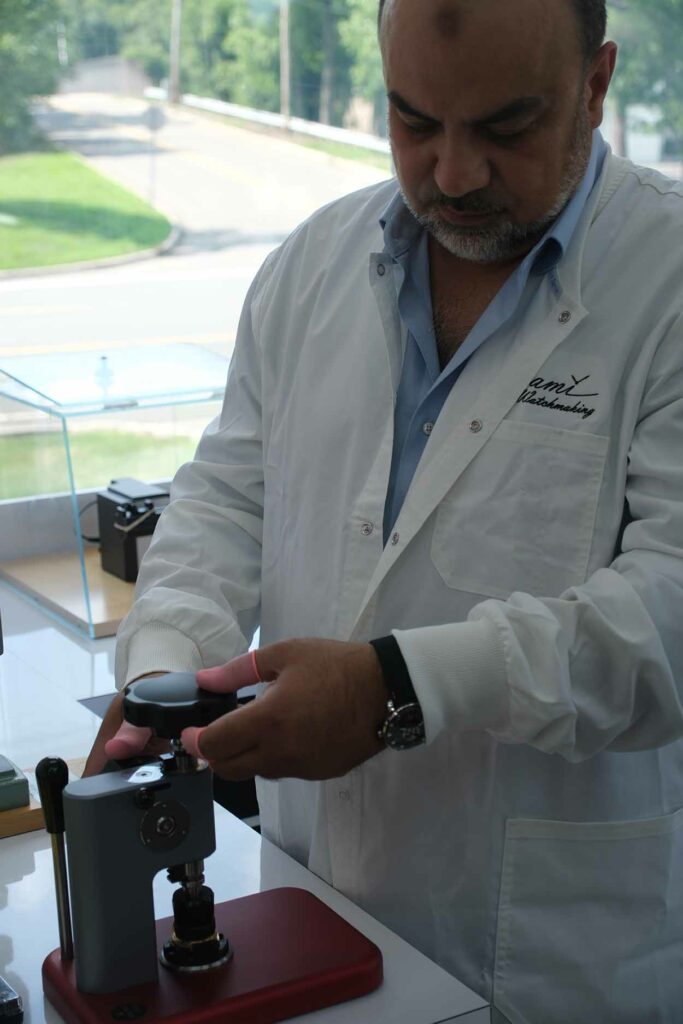
Water resistance in watches denotes their ability to withstand water pressure, with the term “waterproof” now deemed misleading and prohibited by the ISO. To clarify water resistance ratings for consumers, ISO has established testing protocols, and it’s essential for watch owners to periodically check their timepieces for moisture and gasket integrity. At Shami Fine Watchmaking, we utilize advanced technology to evaluate water resistance and recommend annual testing, or more frequent assessments for those with active lifestyles involving water sports, to ensure optimal performance and durability.

What if I drop my watch and it stops working?
It is crucial to have it examined at our Service Center following any significant impact or shock, as such events can damage delicate components like the balance staff.
What if my automatic watch stops working?
An automatic watch relies on the movement of the wearer to wind the mainspring and keep accurate time. If the watch is not worn regularly, it can wind down and stop functioning. Additionally, factors such as lubrication degradation, dust accumulation, or damage/wear to internal components can also lead to functionality issues. Regular maintenance and periodic winding—even when not worn—can help mitigate these problems.
What if my watch starts running slow or stopping periodically?
Regular maintenance is essential to ensure the longevity and accuracy of your watch, so it’s advisable to change worn parts, lubricants, and gaskets every three to five years for a mechanical watch and seven to ten years for a quartz watch to protect its internal mechanics and prevent moisture or dust/dirt from affecting performance.
What if my watch is running fast?
A watch running fast can stem from several issues, including everyday wear and tear, physical impacts that may misalign or damage components like the hairspring, or exposure to magnetic fields that disrupt the timekeeping mechanism. Regular maintenance and careful handling can help mitigate these problems and ensure the watch remains accurate.
What if my automatic watch is running slow?
To ensure optimal performance of your automatic watch, it’s important to either manually wind it or wear it regularly to keep the mainspring adequately charged. Typically, these watches can maintain accurate time for around 36 hours when not worn, but if you notice it running slow, professional maintenance may be necessary. We recommend servicing the movement every 3-5 years based on your usage to keep your watch running smoothly.
What if the crown continues to wind and doesn’t stop, or not wind at all in a manual-wind watch?
If the mainspring in a manual-wind watch is broken or malfunctioning, it may cause the crown from being able to wind the watch or not wind it at all. In such cases, replacing the mainspring is necessary to restore the watch’s proper timekeeping and functionality. Regular maintenance can help prevent this issue and prolong the lifespan of the watch’s movement.
What if the crystal on my watch fogs up?
It’s crucial to ensure that the crown on your watch is securely tightened to prevent moisture from entering. The crown, crystal, and internal gaskets may have been compromised over time. If you suspect any issues, it’s advisable to have these components replaced along with a full maintenance check, as even water-resistant watches are not impervious to the elements. Regular servicing is essential to maintain your watch and extend its lifespan.
Swimming & Showering
What measures do I take if I accidentally jump in a pool with my watch on?
If water or moisture gets inside your watch, it can wreak havoc on its delicate movements. If this happens, we suggest that you place it on a radiator, lamp or hotplate. Water and moisture are watches greatest enemy.
Warming the back of the watch will reduce moisture and keep the water away from its interior. It would probably be a good idea to bring your watch into our service center so we can make sure that the water didn’t cause damage.
What if I accidentally shower while wearing my watch?
We suggest that although your watch may be water resistant, it makes sense not to shower with your watch. Soaps, shampoos, and conditioners are not friendly to the delicate and intricate movements. If your timepiece is exposed to any liquids, rinse with tap water and dry off with a soft cotton cloth or towel.
Can I swim with my Chronograph?
Although many chronographs are robust, durable watches and are usually water resistant; they are not built for swimming pools or, the open seas. If you find your chronograph getting wet, make sure to dry it off quickly. Adjusting the crown and or the bezel while underwater can break the seals of the gaskets allowing water to enter into the movement. It’s a good idea to make sure that the crown is screwed down tightly to avoid water entry.
If my watch is water resistant, can I dive into a pool?
Significant forms of shock and impact can cause damage to a watch. If your watch is not meant for diving, we suggest not diving with it. There is a change in pressure as soon as one dives into a pool. The more times one dives into the pool, the greater the chances of water getting forced through the gasket which will damage the inside of your watch.
What if my Leather straps get wet?
Leather straps are not meant to get wet. Water, moisture, liquids, and lotions may cause the straps to wear out quickly. Water, liquids, and lotions can also discolor the fine leathers finish if your leather strap gets wet wipe of immediately with a soft cotton cloth or towel.
If you have any questions or concerns our Shami watch experts are available to educate, inform and help.